
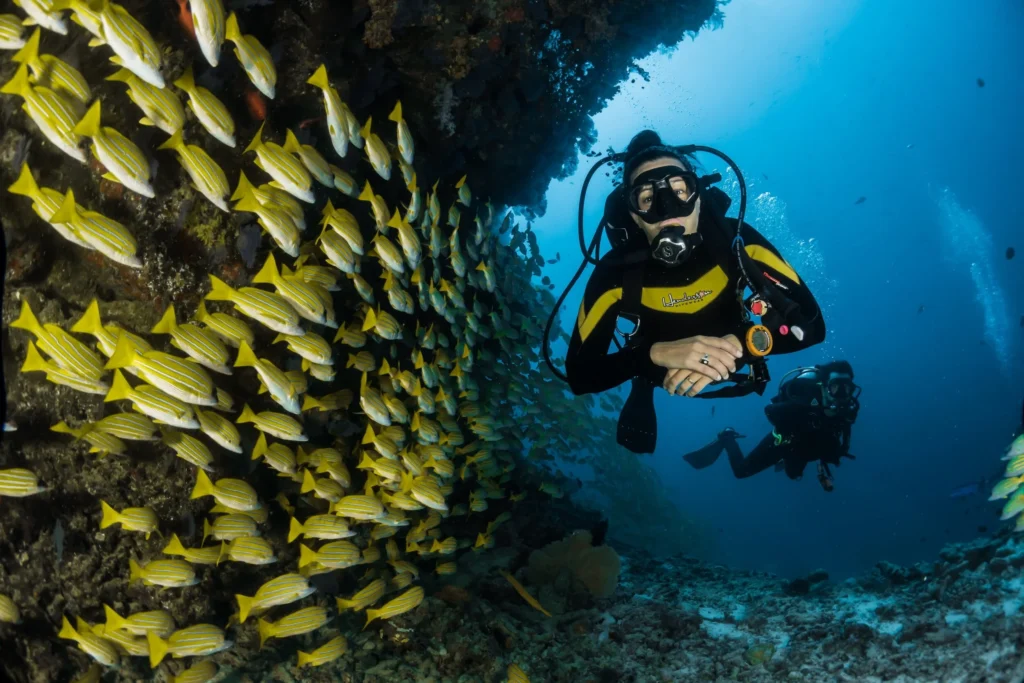
Is scuba diving on your bucket list? Perhaps it’s an idealized notion that has captured your imagination. Even if you’ve never tried it before, you can readily enjoy the experience. You should obtain proper instruction and undertake a little preparation before you dive into this new pastime. The following outlines the reasons to take up scuba diving, where you can dive, and how to begin.
Why you should try scuba diving
Learning to scuba dive is an excellent way to travel the world. There are so many interesting ocean areas where you can practice your dive skills. Swimming past coral reefs and through schools of colorful fish is among the rewards. The tourism industry catering to underwater diving has much to offer in terms of local history and hospitality.
For new scuba divers, stepping outside of your comfort zone is often part of the process—and it’s how confidence and skills are built. Learning a new skill is one way to stay invigorated and engaged with life. You’ll be taught the physics of diving and how the equipment works. You’ll also find a lot to learn about the marine environment, including the various life-forms and the importance of protecting our oceans.
Staying physically active is necessary for optimal health, and scuba diving is something you can participate in at nearly any stage of life. Once you’ve accomplished the basics, it’s a sport you can stay with as you age. The right amount of exercise keeps you engaged, and the excitement of discovery makes every dive rewarding.
Scuba diving can be a very meditative activity, as you concentrate on your breathing, slowly and silently moving through the peaceful underwater world. As such, it supports relaxation and stress management. Every dive is different and reveals amazing sights you’ll only encounter in the marine environment. The sense of awe that comes with seeing seahorses, turtles, and other wildlife is another therapeutic aspect of the activity.
Finally, becoming part of a scuba diving community is another benefit of learning to dive. Typically, you’ll take a few courses and this is where you’ll meet other newcomers and diving experts.
Where to scuba dive
You can scuba dive from just about every continent, although conditions in certain parts of the ocean are more suited to divers at the top of their game. However, the average fan of the sport will find many areas where they can enjoy an excellent diving session. You may not have to go far to find a coastal place that caters to scuba diving or a local dive club that you can join.
If you want to go farther afield, there are places around the world with wonderful and diverse marine ecosystems that are perfect for underwater exploration. Each is well worth a visit on its own merits. Divers from the United States, Canada, and Europe often gravitate to the Caribbean Sea for destination dives. This part of the ocean has a larger number of dive operations than anywhere else in the world. The hundreds of islands in this tropical paradise supply a rich variety of dive options. The waters are warm, underwater life is abundant, and the coral reefs are stunning. The Gulf Stream actually flows north from the Caribbean Sea into the Bahamas and Florida Keys, places that might be a little closer to home for some Americans.
Another choice for scuba diving is the Central-South Pacific where there’s a vast expansive region containing quite a range of dive sites, each distinct from the other. What’s unique about this part of the world is that a number of places haven’t been explored yet by divers. The Central-South Pacific straddles the equator and represents over one-eighth of the world’s surface. The waters here are mainly warm and clear with visibility of 80 feet or better throughout the year.
How to get started
If you’re already a swimmer or have done some snorkeling underwater, it won’t be too much of a leap to get into scuba diving. That said, learning the sport requires professional instruction.
A scuba instructor will introduce you to recreational diving and explain what it entails. Basically, it’s about diving within a particular set of parameters. That is, diving up to a depth of 130 feet where light from the water’s surface is still visible. There are also specific equipment and training requirements. Expect to invest in a skin suit or short wet suit for swimming in warm water and a heavy dry suit for cold water plunges. Once you earn an entry-level certification, you can dive recreationally without direct supervision from a professional diver.
Since scuba diving comes with a certain amount of risk, be sure to find a reputable dive school with good instructors and top-notch equipment. You may pay a bit more, but it will be worth it. If you’re traveling to dive locations elsewhere in the world, you may want to set aside enough money for guided dives.
In closing
Scuba diving can be a truly wonderful adventure. With time and patience, you’ll continue to build your skills and confidence.