
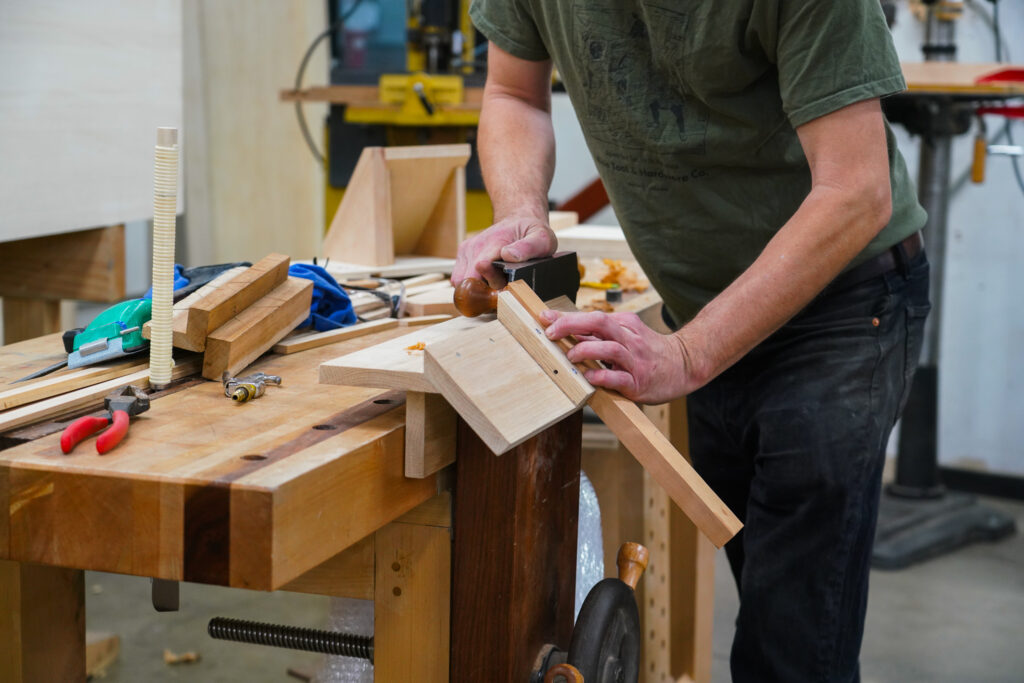
There’s something very gratifying in crafting something by hand, and working with wood is no exception. Wood was one of the first materials ancient humans used to create objects such as weapons, utensils, and other basic tools. Today, we still treasure wooden objects like fine furniture, bowls, and carved sculptures.
Woodworking is an excellent hobby if you’re looking for a pastime that allows you to exercise your creativity, produce something physical, and work on a project that blends art with engineering. Many people find woodworking meditative and relaxing as well.
Any new skill requires learning the tools and terms of the trade, so that’s a good place to start when you’re picking up the hobby.
Deciding on tools
You don’t have to spend a lot of money on equipment to get going—you can actually do a lot with a few simple hand tools. This will give you time to get comfortable with the craft and offer a sense of accomplishment.
You’ll need clamps, chisels, a handsaw, a mallet or hammer, and a selection of screwdrivers or one with multiple heads. Clamps secure your project in place while you work. Chisels are usually used in conjunction with a hammer or mallet to shape the wood. In addition, you’ll need a combination square, tape measure, and pencil to measure and mark accurately, plus sandpaper of various grits. Set up your workspace somewhere you won’t mind a lot of sawdust or wood chippings.
You’ll find there are different types and sizes of tools designed for distinct kinds of projects. It’s good to ask for guidance, either at the shop where you purchase the tools or from an experienced woodworker. Explain that you’re just learning and trying your hand at making a few simple items.
When you’re ready to add power tools, a drill and jigsaw should be your go-to items. You might also consider investing in a circular saw, dowel jig, and hand plane. These tools will expand the range of projects you can tackle.
Woodworking terminology
Some terminology might be self-evident but it’s good to go over the typical terms you’ll hear applied to this hobby. Each of the following refers to a woodworking technique.
Finishing is the process of protecting the surface of your wooden craft by applying a finish. This can include a substance that penetrates the wood or adheres to the surface. There are a range of potential finishes to refine and safeguard your completed project, such as varnishes, stains, shellac, oils, lacquers, and others.
Jointing involves getting wood edges ready to be joined. The pieces of wood are smoothed and prepared to be glued or connected to one another, at an angle or one flat surface fixed to another.
Drilling is just about making holes in the wood with a drill and bit. A power drill spins the drill bit either clockwise or counterclockwise. It moves clockwise to cut into the wood, and the counterclockwise motion is for removing the bit. The size of hole you want to make will dictate the particular bit you need. A twist drill bit is the one you’ll become familiar with as it’s commonly used for creating smaller, standard-sized holes in wood. There are other kinds of bits, including auger bits, spade bits, and brad point bits.
Planing refers to removing unwanted material from the wood’s surface with a hand or machine plane. Sanding is the next step to finish and smooth the wood, while routing is a technique used to finish edges and produce various shapes. It’s about cutting and hollowing out an area of the wood to get the desired contours—for example, to produce the grooves in furniture and cabinetry. The tool used for this is called a router.
As it sounds, sawing involves cutting wood to the desired size. There are a huge number of saw types, each defined by the cuts they produce, from handsaws and circular saws to table saws, jigsaws, and bandsaws.
A few important points
Safety is paramount when you’re woodworking, so make sure you’re outfitted with the right equipment—think safety goggles, a mask, ear protection, gloves, and proper clothing. Read the instructions before using a tool and follow them. You’ll need to work in a well-ventilated area with good lighting and enough space to move around comfortably, with no tripping hazards.
While you can learn a lot by watching online videos, asking questions on woodworking forums, and reading about woodworking, it’s a good bet to take a class or two from a professional. Alternatively, see if there are any woodworkers among your friends and family who can respond to questions and offer advice.
In closing
Once you understand basic woodworking terms and become familiar with some simple tools, you’ll be well on your way to enjoying a fun new pastime—one that will give you something tangible to show for it.