
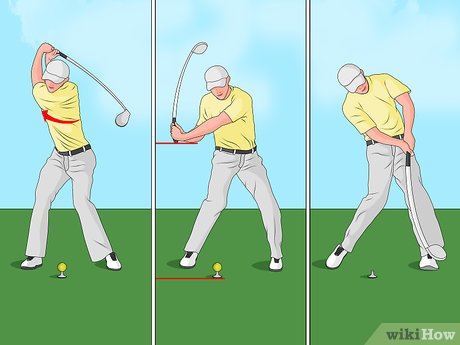
From children to older adults, people of all ages step up each year to learn the game of golf. One of the great things about golf is that, with a few introductory lessons and some practice, it’s a sport you can participate in well into your senior years. No matter your level of proficiency, getting better at golf means perfecting a few foundational skills—which takes lots of practice. Let’s start with the golf swing and consider six ways you can improve your game.
- Get a grip
Getting a good golf swing starts with holding the club properly. A firm grip is essential for adequate control. The way you grip the club should feel natural, and there are three options to try out.
The baseball or ten-finger grip is when all ten fingers are on the club. This approach works well for beginners and people with smaller hands. The leading hand (the left hand for right-handed golfers) is toward the top of the club and the trailing hand (the right hand) is right below it, with no gap. The thumb of the leading hand should point down the club, not wrap around it with the rest of the fingers.
The overlapping grip is used by most golfers, including the majority of professionals. In this case, the leading hand grips the club above the trailing hand, with the thumb of the lead hand pointing down the shaft and covered by the fingers of the trailing hand. The pinky finger of the trailing hand rests between the index and middle fingers of the lead hand, helping the hands work together as a single unit during the swing.
The third choice is the interlocking grip, which involves locking the pinky and ring finger on the trailing hand with the index finger of the leading hand. This locks the hands and wrists together.
Experiment with all three kinds of grips to see what seems to work best for you.
- Watch your stance
How you stand before you take a swing is important and influences how much control you’ll have when you hit the ball. To get a good swing, plant your feet shoulder-width apart with your weight evenly distributed, your knees slightly bent and your spine straight. Lean forward a little.
Once you’ve got the stance in order, perfect how you place the club in relation to the ball. Position the club behind the ball so that the ball is square with the club face. This will help you to maintain a consistent aim.
At the same time, note your posture to make sure you’re relaxed, but feeling strong and steady. A word about the distance between your feet: If you’re using a short iron, having your feet closer together gives you more control than shoulder-width.
- Focus on the ball
One of the worst things you can do is take your eyes off the ball. Certainly, you might want to look ahead to confirm where you’re aiming. This will help you determine how far you intend to hit the ball and assess how much power you might need to put into your swing.
That said, plan to keep your eye on the ball as you bring your club towards it and follow the trajectory when it sails through the air. Training yourself to focus on the ball will help you maintain a solid and controlled swing, the path of the club pivoting around your head. In addition, don’t worry about losing track of where you ball went as your golfing partner can help with that.
- Swing smoothly
Your golf swing should have a smooth rhythm to it. Pay more attention to the movement rather than the amount of strength behind it, and you’ll be more effective. If you attempt to put too much power into your swing, you’ll risk over-swinging and have less control—lots of beginning golfers overcompensate like this. In this case, your shots will be inconsistent.
Instead, be more purposeful and practice keeping a three-to-one ratio in terms of speed when you move through the swing. In this respect, you want to have your backswing about three times slower than the speed you use for your downswing. One tip is to count it out in your head.
- Watch the distance
Mastering your golf swing involves learning how to use the different types of clubs to your advantage. Whether you’re playing with an iron, putter, wedge, wood, or hybrid, it’s necessary to know the benefits of each kind of club and when to use them.
In addition, you should become familiar with the distance you’re able to cover with every club. By practicing taking swings with each type, you’ll appreciate where your abilities lie and the average distance you can hit with different clubs. In turn, you can make better choices on the course when deciding which club to use for a specific shot.
- Practice your short game
Perfecting your golf swing is also about your short game. Chipping, pitching, and putting requires close attention to how you use the club to connect with the ball. Improving these moves is about lining up your shots carefully and building accuracy. Trying out different clubs and taking your time will get you there.
Use these tips for a better swing
By following this advice about your grip and stance, keeping your focus on the ball, smoothing your swing, paying attention to distances, and working on your short game, your golf swing will improve noticeably.