
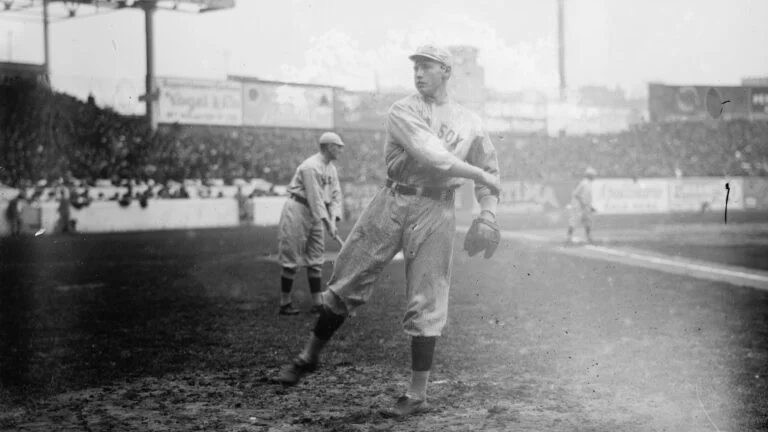
While the history of baseball in America started around 1839, a comparable game called rounders was referenced in an English children’s book circa 1744. The much-loved story was subsequently published in North America a few years later. This is one of baseball’s fascinating facts. The history of the sport is intertwined with popular culture, political issues, and American pride. We will explore what’s behind the game’s trademark call “Let’s play ball!”
Early days in America
One of the first references to baseball in the United States is a New York newspaper’s account of an 1820s baseball club with about 50 members. Around this time, it seems college ball was also played at Harvard College.
Fast forward to 1845 when baseball legend, Alexander Cartwright founded the New York Knickerbocker Base Ball Club. In the first recorded baseball game between clubs, the Knickerbockers challenged the New York Nine, with the event taking place in Hoboken, New Jersey.
This heralded the beginning of America’s love affair with the sport. Multiple clubs formed across the nation, joining either the National League in 1876 or the American League established in 1901. The first World Series of baseball saw the winners of these two leagues competing against each other in 1903.
The question of rules
Many of the rules of the sport developed by the Knickerbockers club continue today. Unlike rounders, which was a similar bat-and-ball game, a player was considered out when tagged by a ball instead of being hit with a thrown ball, thus leading to the use of a harder ball. Other Knickerbocker Rules specified the three-strike rule and the diamond-shaped infield.
That said, while some clubs were quick to adopt the New York version with the Knickerbocker rules, clubs in places like Boston and Philadelphia held on for a few more decades to an older sport that used a soft ball. This was referred to as the Massachusetts game. During the American Civil War, solders from New Jersey and New York taught the Knickerbocker method of play to others and when the war ended in 1865, the New York rules became common.
These rules were revised in 1854 to specify the size and weight of the ball and the infield dimensions, attributes that still substantially govern the sport today. After the Civil War, there was an explosion of baseball clubs around the country. Although the big-city teams were the main contenders, the game was widely played and was quickly becoming a national pastime.
Baseball as a profession
The New York Knickerbockers and similar teams of that era were true clubs where members paid dues. People joined for the social contact and the enjoyment of playing baseball. However, the sport started to become commercialized during the 1860s. One example of this was the construction of an enclosed baseball field in 1862 complete with stands for spectators and an admission fee. This ushered in organized tournaments with scheduled games between different clubs. The crowds came in droves.
With more riding on winning a game, clubs encouraged players to specialize in a particular position and the best people got more practice time on the field. By 1865 to 1866, some clubs were recruiting and hiring players with the skills they needed for individual games. The intense competition this inspired between rival teams is what drew the spectators.
The first strictly professional baseball team, named the Cincinnati Red Stockings, débuted in Ohio in 1869. The company toured throughout the United States that same year, playing from San Francisco to New York. They won 56 games and tied one, illustrating what a truly professional team was capable of. Other cities jumped on board with the idea of forming expert teams.
A shifting landscape
By 1871, the National Association of Base Ball Players that represented amateur players was replaced by the National Association of Professional Base Ball Players. This organization gave way in 1876 to the National League of Professional Baseball Clubs, replacing players’ associations with clubs. As owners exerted control over the game, players began to organize. In 1886, the National Brotherhood of Base Ball Players publicly challenged the salary cap of $2,000 instituted by the National League, but the league owners refused to budge. Various subsequent attempts by players to achieve fair compensation followed.
It wasn’t until the mid-20th century that players became empowered to negotiate higher pay. By 1968, with the assistance of a skilled labor lawyer, the Major League Baseball Players Association secured a doubling of the minimum salary to $10,000. In the ensuing years, a significant bump in compensation was achieved, as well as other benefits such as loosening the restrictions around free agency.
In closing
Baseball has grown from a sport played in small club venues to a game that packs stadiums and attracts viewers from across America and around the world. Amateur players everywhere dream of a professional baseball career.