
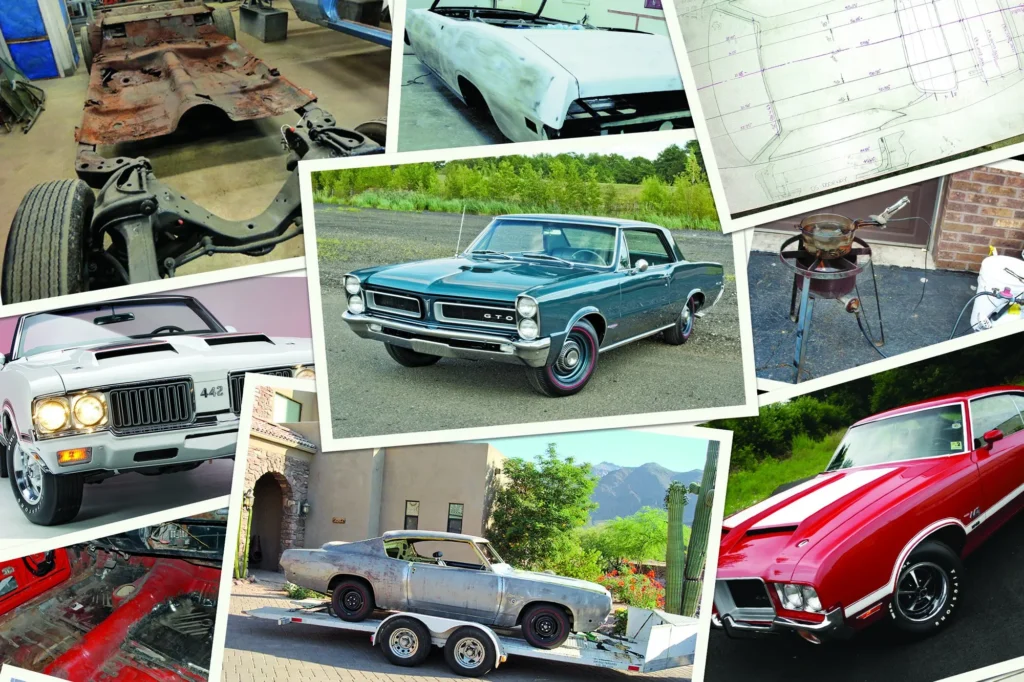
Taking an antique automobile from worn-out beater to showpiece can be immensely satisfying. Besides the satisfying payoff at the end, restoring a classic car can be a fun project to tackle if you enjoy working with your hands, solving problems, and learning new skills. And of course, classic cars and trucks are just plain cool. Here’s what you should know before you dive into a restoration or rebuild.
Put a plan in place
Any successful project starts with a good plan, and restoring a vehicle is no exception. You’ll want to figure out your budget and timeline. Keep your expectations reasonable and be ready to deal with unexpected costs or delays—some jobs can take years.
Planning requires deciding your end goal for the project. Do you simply want to get the car back in good running shape, or do you imagine jazzing up your ride a bit? The latter will require more money, so expect to shop around, do your research, and determine where to source salvaged parts and buy new.
Be sure to consider all aspects of the project. For example, do you have the tools needed or might you have to borrow, rent, or buy them? Do you know the best mechanics, restoration specialists, and body shops for any work you cannot do yourself? Have you factored in disposal costs?
Perhaps the number-one factor to consider is your choice of car. It’s easier to source parts for more popular models—and if you can’t get OEM or aftermarket parts, you might need expensive custom fabrications. You also want to a choose a car that doesn’t have much rust. Surface rust can be removed, but if there’s major rust damage to the frame, you may need welding to fix the problem. Can your budget (and your stress levels) handle these expenses? If not, pick a different car.
Set up your workspace
You’ll need a well-ventilated space that’s large enough to comfortably work on the vehicle. If you’re using a single-car garage, it can be done but having extra space is always nice. If you have a large shed, barn, or outbuilding, so much the better.
When you’re preparing the workspace, it’s a good idea to organize equipment and parts in bins, containers, or shelving with labels so you can find what you need quickly. Your workspace should also have good lighting with strong overhead lights and a handheld work light. A fire extinguisher rated for chemical and electrical fires is a must as well.
Get the right tools
If you’re at all interested in classic car restoration, you probably already own some of the tools that are most important for the job. Wrenches, sockets and ratchets, pliers, a jack and jack stands, and cordless drills/drivers are the basic tools of your trade. An engine crane and an air compressor to power air tools will make your job a lot easier as well. You’re probably going to go through a lot of WD-40 or other penetrating oil, too.
Depending on how much body work you’re doing, you might find yourself needing a body repair kit, sander, paint stripper, trim remover, and angle grinder. Don’t forget you’ll need a shop vac and other cleaning equipment.
This may sound like a lot, and it is. So, don’t waste money buying a tool or gear until you’re sure you need it.
Assess what the vehicle needs
Take your time to sort out the work required to bring your car back into good running order. Spend time online reading advice from car restoration sites, forums, and YouTube videos. Join a local club and attend auto shows and swap meets. Joining an internet group with a forum where you can ask questions is also helpful.
Getting a professional to have a look at the vehicle is also a good move. They should be able to tell you about weaknesses and problems with the model to check for and come up with a list of needed repairs. The more expert advice you have, the better.
Be strategic
Restoring a classic car means taking care of any rust quickly. Experts recommend doing this first, although you may want to get the car drivable first and then go back and address the rust. It really depends on the state of the vehicle and if the rust prevents you from making other repairs.
Take your time disassembling the vehicle and examining the parts. This will show you where the bulk of the job will be and how to start off. Be ready to shift gears and readjust your game plan accordingly. Restoring a classic auto requires both patience and persistence. Safety is critical because you’ll be moving heavy parts, working around sharp edges, and using power tools, chemicals, and oil. Err on the side of caution to avoid getting hurt.
Make a plan for success
There’s considerable upfront effort when you’re restoring a classic car. Having a plan, setting up your workspace, choosing the right tools, assessing the state of the vehicle, and being strategic is the way to begin.